


Air conditioning is important to commercial and industrial facilities for maintaining occupant comfort, protecting critical equipment and ensuring proper indoor air quality. For many facilities, however, electric cooling systems can contribute to high peak demand charges and rate schedules, affecting energy costs all year long.
Natural gas absorption cooling can help you level the playing field during peak demand periods. Gas-fired absorption chillers are a perfect fit for facilities with:
- High thermal loads
- Low fuel costs
- Annual cooling loads of 1,500 hours or more
- Access to waste heat recovery sources
How absorption chillers work
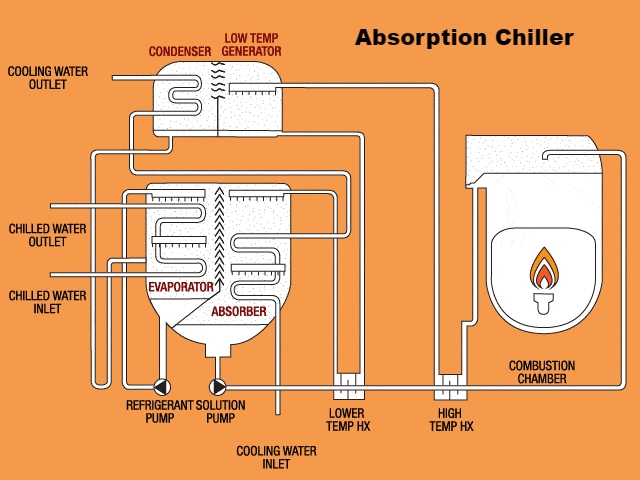
Absorption chillers use heat to provide cooling, with water as the primary refrigerant. When water is absorbed and then released from a lithium bromide solution, a phase change occurs in a partial vacuum, leading to cooling.
Applications and benefits
Natural gas absorption chillers come in a wide variety of sizes. However, because these systems typically have a higher initial cost than electric units, the first-cost economics are more favorable in large tonnage applications.
Absorption chillers are more cost-effective when packaged with a combined heat and power system that provides heat to power the chiller unit. In addition to lowering peak demand charges, these chillers:
- Increase energy efficiency if waste heat is recovered
- Eliminate harmful chlorofluorocarbons
- Reduce greenhouse gas emissions
- Lower maintenance costs
- Avoid expensive electric system upgrades
Absorption chillers are used in a wide variety of commercial and industrial applications, including hospitals, schools and office buildings.
The peak demand trap
High loads strain the electric grid, and customers are asked to share in the cost burden of generating more expensive power. For most facilities, the cost of electricity is made up of two components — consumption and demand.
Kilowatt demand capacity charges comprise as much as 50% of an electric bill. Because demand meters typically record the rate of energy use over 15-minute time increments, one energy-intensive interval can result in a high demand charge applied over an entire month's electric bill.
A high peak demand capacity during one period can affect your energy bill over the course of the entire year if the electric utility has a ratchet clause in its rate structure in which the demand charge for each month is based on a percentage of the highest recorded peak demand over the previous 12 months. Thus, a high peak demand level in one month can increase your energy costs throughout the rest of the year.
Natural gas to the rescue
Gas-fueled absorption chillers provide one way out of this dilemma and can provide additional savings.
Demsey Manufacturing in Waterton, Connecticut, switched to natural gas cooling to reduce peak demand costs by installing 12 gas absorption chiller-heaters, two gas absorption chillers and two reversible gas heat pumps. The energy cost savings was 30%.
Although it's more expensive to purchase, natural gas absorption cooling is a reliable technology for minimizing peak demand charges and reducing environmental impact with a reasonable return on investment.